

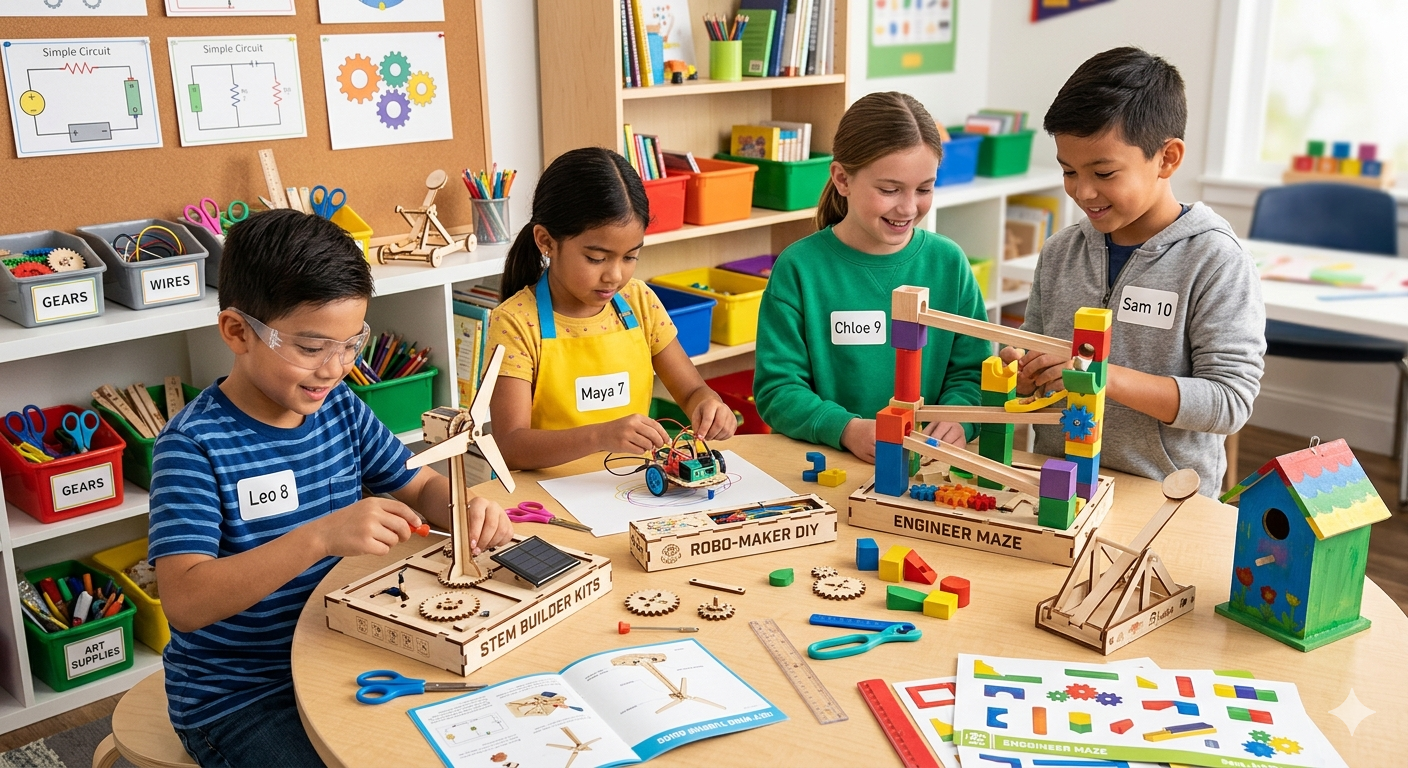
In the modern digital age, parents are increasingly seeking ways to pull their children away from screens and back into the world of tangible, hands-on learning. Educational DIY toys have emerged as the frontrunner in this movement. Far beyond simple playthings, these “do-it-yourself” kits serve as the bridge between theoretical knowledge and practical application, fostering a generation of thinkers, makers, and problem-solvers.
The Power of “Learning by Doing”
The core philosophy behind educational DIY toys is rooted in experiential learning. When a child builds a hydraulic claw or assembles a wooden solar-powered car, they aren’t just following instructions; they are engaging with physics, mechanics, and engineering in real-time.
Standard off-the-shelf toys often provide instant gratification but offer limited cognitive shelf life. In contrast, DIY kits require patience, focus, and a bit of “trial and error.” This process is crucial for developing growth mindsets. When a gear doesn’t turn or a circuit doesn’t light up, the child must troubleshoot. That moment of “Why isn’t this working?” is where the most profound learning happens.
Bridging the STEM Gap with Creative Play
STEM (Science, Technology, Engineering, and Math) can often feel intimidating when presented in a textbook. Educational DIY toys strip away the complexity and replace it with curiosity.
- Mechanical Understanding: Building simple machines helps children visualize how torque, friction, and leverage work.
- Electronic Literacy: DIY kits that involve basic wiring teach the fundamentals of electricity safely and intuitively.
- Spatial Reasoning: Transforming flat, 2D components into a 3D structure is a masterclass in spatial awareness.
By the time these students encounter these concepts in a classroom setting, they already have a mental “anchor” based on their playtime experiences. They don’t just know what a series circuit is; they remember the glow of the LED they wired themselves.
Beyond Hard Skills: The Hidden Benefits of DIY Kits
While the educational value is obvious, the psychological and emotional benefits of educational DIY toys are often underestimated.
1. Confidence Through Completion
There is a unique sense of pride that comes from saying, “I made this.” Finishing a complex DIY project provides a tangible boost to a child’s self-esteem. This “earned confidence” is far more sustainable than empty praise because it is backed by a physical result.
2. Enhancing Fine Motor Skills
Handling small screws, connecting delicate wires, and aligning wooden tabs requires precision. For younger children, these activities are essential for developing the dexterity and hand-eye coordination needed for writing and other complex tasks.
3. Eco-Consciousness and Material Literacy
Many high-quality DIY kits today prioritize sustainable materials like laser-cut plywood or recycled plastics. By working with these materials, children develop an appreciation for craftsmanship and environmental responsibility, moving away from the “disposable” culture of cheap plastic toys.
How to Choose the Right Educational DIY Toy
With a sea of options available on platforms like Alibaba and Amazon, selecting the right kit can be overwhelming. To find the best educational DIY toys for your child, consider the following “Three-P” framework:
- Pace: Does the complexity match the child’s age? A kit that is too hard leads to frustration, while one that is too easy leads to boredom.
- Passion: If your child loves animals, look for bio-mechanical DIY kits. If they love cars, look for solar-powered racers. Alignment with their interests ensures long-term engagement.
- Purpose: Are you looking to improve their math skills, or are you focused on artistic expression? Many DIY toys now blend “STEAM” (adding Art to STEM) for a more holistic approach.
The Role of Parents: Guide, Don’t Do
The biggest mistake a parent can make with educational DIY toys is taking over the assembly. The value lies in the struggle. Your role should be that of a “consultant”—offer a hint when they are stuck, explain a difficult term, but let their hands do the work. This collaborative environment strengthens the parent-child bond while keeping the child in the driver’s seat of their own education.
Final Thoughts: Investing in a Maker’s Mindset
At the end of the day, educational DIY toys are about more than just building a model; they are about building a mindset. In a world that is becoming increasingly automated, the ability to understand how things work—and the confidence to fix or create them—is a superpower.
By integrating these kits into your child’s routine, you aren’t just buying a toy. You are providing them with the tools to deconstruct the world around them and the imagination to build a better one.
Whether it’s a simple wooden puzzle or a complex programmable robot, the journey from a box of parts to a functional creation is an odyssey of discovery. It’s time to stop just playing and start building.